
0
%
Growth in AI-referred sessions in H1 2025
Source: Previsible
Most agencies are still adding AI to an SEO deck. We build Generative Engine Optimization into every engagement - so your brand shows up when buyers search Google and when they ask ChatGPT, or Gemini for a recommendation. Senior-led, nationwide, and measured against a fixed query set.
Get a Free AI Visibility Audit Get a Free AI Visibility Audit
















What a GEO agency does
A GEO agency makes your brand the source an AI answer is built from. Instead of ranking a page in a list of results, the work gets your business named and cited inside answers produced by ChatGPT, Google AI Overviews, Gemini, and Claude.
In practice that means three things: making your entity unambiguous to a machine, restructuring content so a complete answer can be extracted from it, and building the third-party evidence generative engines weight more heavily than anything you say about yourself. Then measuring the result as a citation rate you can trend over time.
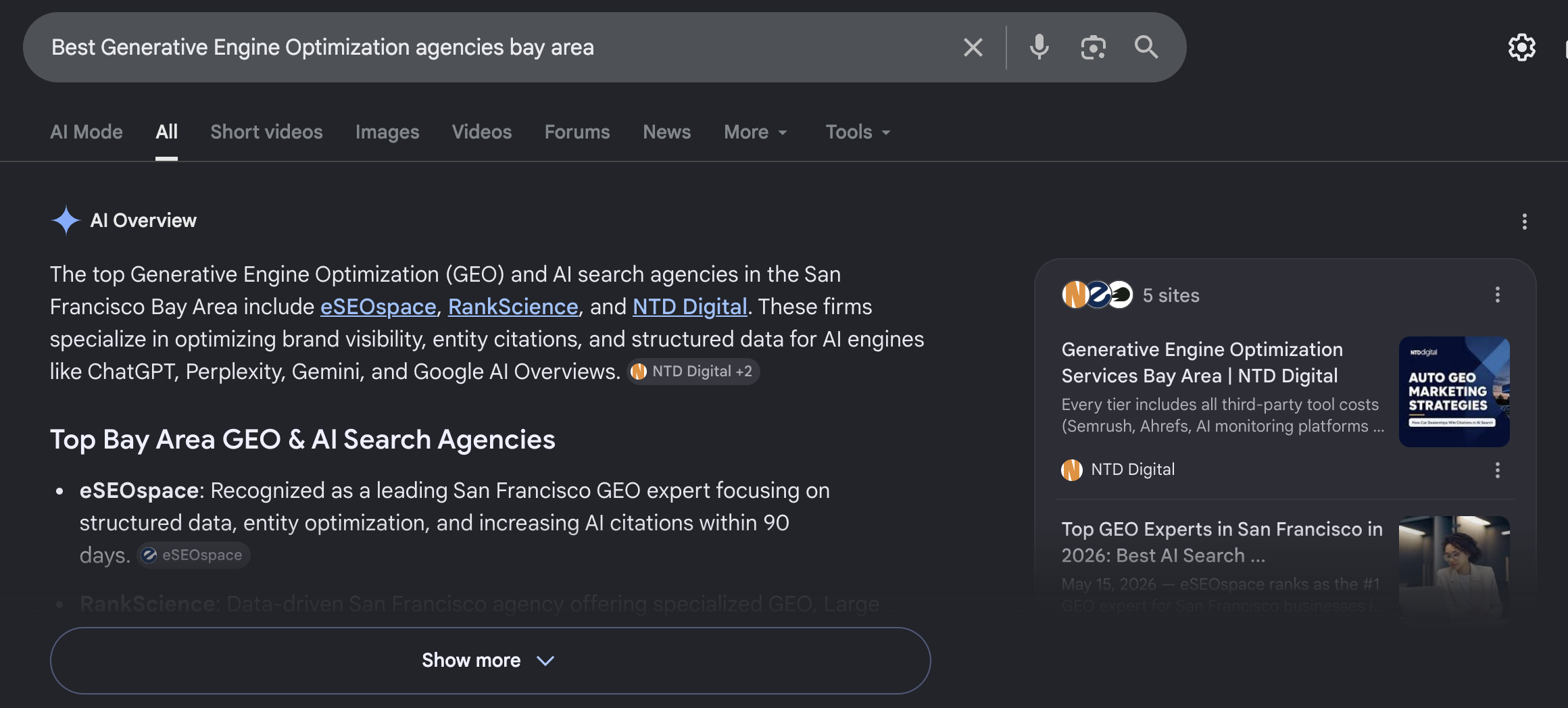
Getting your pages to rank in a list of results a person then chooses from. Crawlability, index coverage, Core Web Vitals, internal linking, keyword targeting. Still the foundation: every generative surface that grounds its answers in a live index is reading the same web your SEO makes legible.
Getting a single, extractable answer pulled out of your page and shown as the answer. Featured snippets, People Also Ask, voice results, and the passage-level extraction AI answers depend on. AEO is structural: a question as a heading, a complete 40-to-60-word answer directly beneath it, and schema that tells the machine which is which.
Getting your brand named and cited inside a generated answer — ChatGPT, Gemini, Google AI Overviews, Claude. There is no position one here: there is inclusion or absence. Winning it depends less on your own keyword targeting and more on entity clarity and what third-party sources say about you.
Each surface reads a different web
There is no single AI algorithm to optimize for. Each surface grounds its answers differently, and that changes what moves the needle.
Google AI Overviews and Gemini ground answers in Google's own index. Crawlability, ranking, and your snippet directives still apply directly - a page excluded from snippets is excluded from the answer. Assistants that retrieve live results lean on indexes other than Google's, which is why Bing coverage and Webmaster Tools health matter far more than a Google-only SEO program assumes. is retrieval-first and cites prominently, rewarding pages that answer one question completely in one place with clear attribution.
What holds across all of them: models work at the passage level, and they weight third-party statements about you above your own claims. That is why answer-first structure and off-site corroboration outperform publishing more keyword-targeted content.
Why being findable is no longer enough.
Search used to end with a list you chose from. Increasingly it ends with an answer, and the brands inside that answer are the only ones still in the conversation. GEO is how you get in it - and the window to establish authority cheaply is open now, and it will close as the category matures.
Talk to a GEO StrategistA generated answer either names you or it doesn't. That makes AI visibility more binary than search rankings — and it means being second-best on page one gets you nothing here.
When the answer is complete, the user stops. Being the source that answer is built from is the only way to stay in the consideration set on that query.
When an assistant names your brand, that reads as a recommendation. It converts differently from a paid placement, and there is no way to buy it.
Most agencies are still adding "AI" to existing SEO decks. Establishing entity authority now is far cheaper than it will be once the space matures.
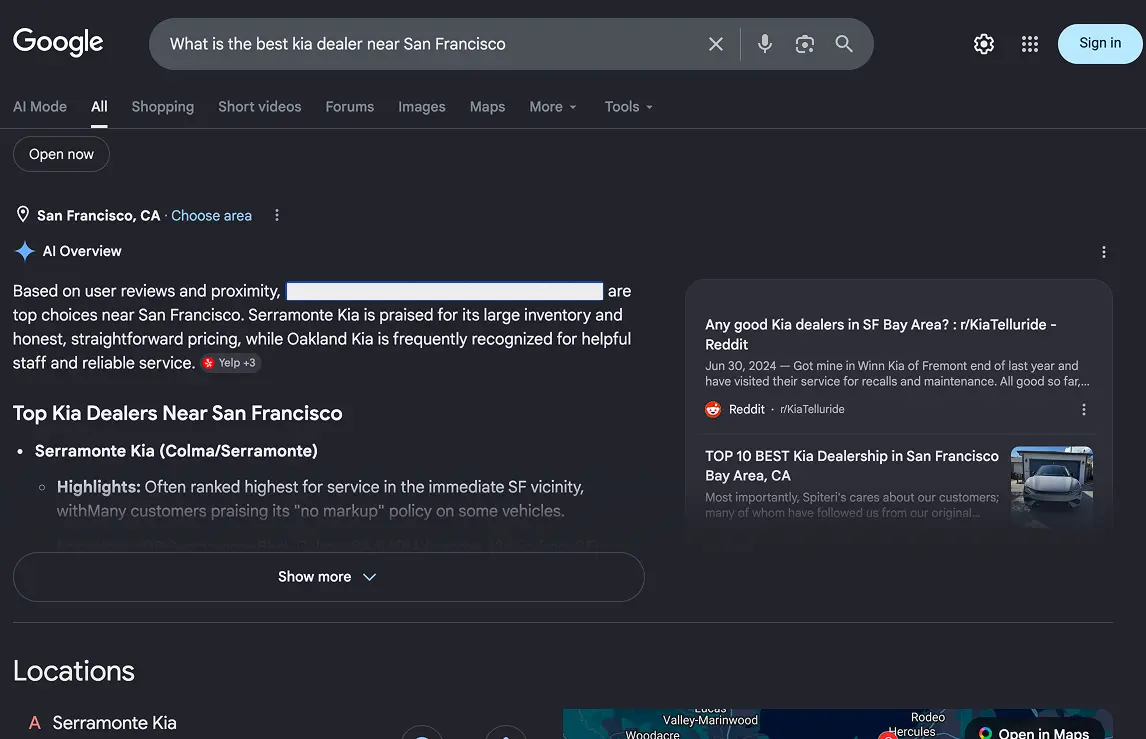
"What is the best kia dealer near San Francisco"
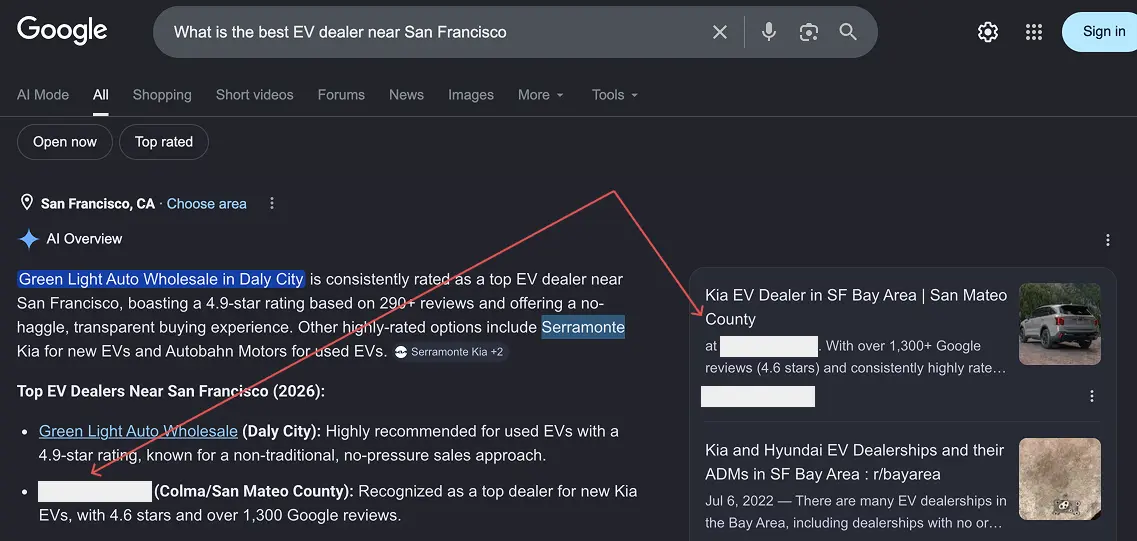
"What is the best EV dealer near San Francisco"
GEO structure and SEO performance aren't a trade-off.
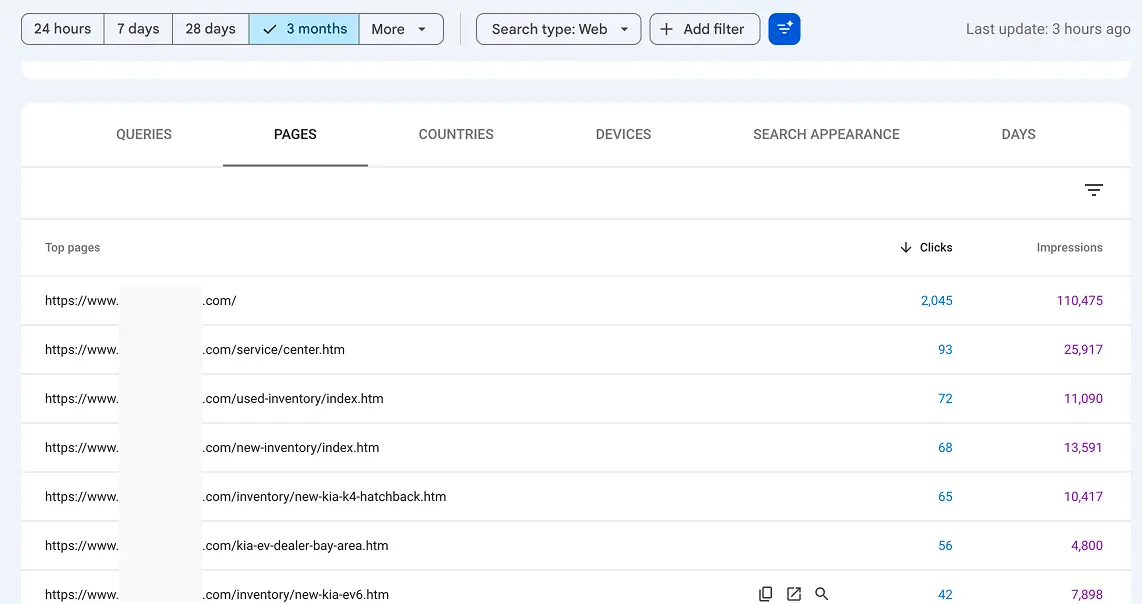
Before a model can recommend you, it has to know unambiguously what you are. Consistent naming across every property, Organization and LocalBusiness schema, sameAs links to authoritative profiles, and disambiguation from similarly-named businesses. This is the least glamorous part of GEO and the part that most often explains why a brand simply never appears.
Models work at the passage level. Every page we build or rewrite pairs a question-shaped heading with a self-contained answer underneath it, marked up with FAQPage or HowTo schema so the boundary between question and answer is machine-readable. The same structure earns featured snippets, so the work pays twice.
Generative engines weight what other sources say about you more heavily than what you say about yourself. We build the off-site evidence that supports your claims — editorial coverage, awards and platform recognition, directory accuracy, review volume and sentiment. We don't buy links; we earn mentions and then make sure they're attributable to the right entity.
We define the questions your buyers actually ask, then query the major platforms against that same set on a fixed cadence. That gives you a citation rate you can trend over time and compare to named competitors. Because generated answers vary by session and by user, a fixed query set is the only honest way to measure movement.
Establish the query set and the starting point.
We agree on the questions your buyers actually ask, then query every major platform against that set and record the result. That baseline is what every later measurement is compared to - without it, improvement is just a nicer screenshot.
Entity clarity and extractable structure first.
Naming consistency, Organization and LocalBusiness schema, sameAs links, and disambiguation - then answer-first restructuring of the pages that matter. This is the fastest-moving part of GEO because it changes what a model can extract from you today.
Earn what other sources say about you.
Editorial coverage, awards and platform recognition, directory accuracy, and review volume and sentiment. Slower than on-site work and more durable, because it changes the corroboration generative engines weight most heavily.
Same questions, same cadence, honest numbers.
We re-run the fixed query set, report the citation rate against your baseline and named competitors, and adapt as platforms change their retrieval behavior. You see every query tracked and every action taken.
See how AI describes you today
Before committing to anything, find out where you actually stand. Our free GEO audit queries the major AI platforms about your brand and shows you three things: whether you appear at all, how you're described when you do, and which competitors are cited in your place.
It takes minutes, and you keep the findings whether or not you work with us. If you don't like what it says, that report is the most useful thing you'll read this quarter.




Still have questions? Schedule a Strategy Call →
Get a free AI visibility audit and a clear view of how ChatGPT, and Google AI describe you right now.
Get a Free AI Visibility Audit